2026 How to Choose the Right Common Mode Choke for Your Projects?
Choosing the right "Common Mode Choke" is essential for effective project design. According to John Smith, a leading expert in EMI solutions, "Selecting the right choke can make or break your project." This statement captures the significance of this component in addressing electromagnetic interference.
Common Mode Chokes filter out unwanted noise in electronic circuits. Their proper selection can improve performance. However, many designers overlook their importance. A poorly chosen choke may lead to inefficiencies. Understanding specifications helps in making informed decisions.
Project requirements vary greatly. Therefore, selecting the ideal Common Mode Choke requires careful evaluation. Factors such as inductance, current rating, and size matter. Design teams should prioritize compatibility with their circuits. Always be ready to reassess your choices as projects evolve.
Understanding Common Mode Chokes: Definition and Functionality
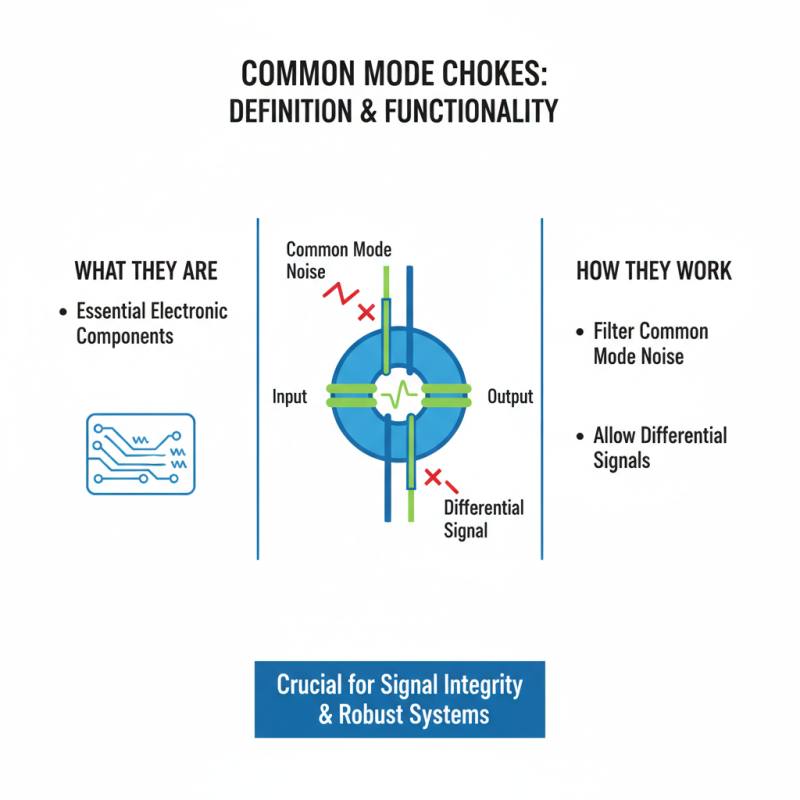
Common mode chokes are essential components in electronic circuits. They filter out common mode noise, which can disrupt signal integrity. Understanding their function is key for designing robust systems. They work by allowing differential signals to pass while reducing unwanted noise.
These chokes consist of two coils wound on a magnetic core. When current flows, they produce opposing magnetic fields. This action diminishes interference from unwanted frequencies. It's vital to select the right choke based on frequency, impedance, and current ratings. Miscalculating these parameters can lead to ineffective noise suppression.
When integrating a choke, consider the layout and positioning. Placement affects performance. Proximity to high-interference sources can reduce effectiveness. If you're unsure, simulate different designs to evaluate performance. Adjust your approach based on the results. Testing is crucial in achieving desired outcomes.
Key Parameters to Consider When Selecting a Common Mode Choke
When selecting a common mode choke for your projects, it’s essential to focus on key parameters. One crucial factor is impedance. The choke's impedance must match your application's requirements. It typically determines how effectively the choke suppresses common mode noise. You should assess the frequency range where the choke operates most efficiently.
Another vital parameter is current rating. This rating indicates how much current the choke can handle without overheating. It is important to choose a choke that can accommodate peak currents experienced in your circuit. Keep in mind that exceeding this limit can lead to failure.
Tips: Always review your application’s power levels. They help in choosing the right choke. Look for chokes that balance size and capability. A larger choke may handle more current but take up more space. This aspect could lead to layout challenges in your design.
Lastly, check the thermal characteristics of the choke. It affects long-term reliability. High temperatures can degrade performance over time. Choose components that remain stable under your expected operating conditions. This decision will improve the overall reliability of your design.
Types of Common Mode Chokes and Their Applications
Common mode chokes play a crucial role in minimizing electromagnetic interference (EMI). They are widely used in various applications, including power supplies and data communication systems. Understanding the types of common mode chokes can significantly enhance your project's performance and reliability.
There are several types of common mode chokes: toroidal, ferrite bead, and disk chokes. Toroidal chokes are known for their high inductance and compact size. They are effective in low-frequency applications. Ferrite beads, on the other hand, are simpler and cost-effective. They are often used for high-frequency noise suppression. Disk chokes possess a larger surface area, making them suitable for heavy-duty applications. Each type has its strengths and weaknesses that depend on the specific needs of your project.
Choosing the right choke can be challenging. Every project presents different requirements and potential hurdles. Sometimes, trial and error is unavoidable. It’s essential to analyze your application's frequency range and load characteristics. Miscalculating these factors could lead to inefficiency. Understanding the key attributes of each type is crucial. This knowledge empowers you to make informed choices that enhance your design's reliability and performance.
Application Scenarios for Common Mode Chokes in Various Projects
When considering common mode chokes for your projects, it's essential to understand their application scenarios. They are widely used in power supplies, automotive electronics, and communication systems. These devices help suppress electromagnetic interference (EMI) and enhance signal integrity. According to a recent market report, the global common mode choke market is projected to grow by 8.5% annually. This growth reflects increased demand for better filtering solutions in sensitive electronic applications.
In automotive electronics, for instance, common mode chokes effectively eliminate noise from engine components. This ensures that electronic devices, like sensors and navigation systems, function correctly. In communication systems, these chokes protect signal quality from external interference. A study found that they can reduce noise by up to 30 dB in high-frequency applications. Choosing the right choke involves assessing the frequency range and the maximum current requirements.
Tips: Always review your project's specific EMI requirements. Consider the choke’s inductance value. It should align with your application needs to ensure optimal performance. Reflect on the mounting style as well. Do you need a PCB mount or an open frame?
Common mode chokes also find use in industrial applications. These scenarios involve complex machinery where electromagnetic compatibility is crucial. Misjudgments in specifications can lead to inconsistent performance. Some projects may not require a choke at all. Evaluate your designs critically to avoid unnecessary complications.
2026 How to Choose the Right Common Mode Choke for Your Projects?
| Application Scenario |
Common Mode Choke Type |
Inductance Value (μH) |
Rated Current (A) |
Impedance at 100MHz (Ω) |
Typical Applications |
| Power Supply Filtering |
Ferrite Core |
10 |
2 |
100 |
Switching Power Supplies |
| Data Communication |
Multilayer Chip |
4.7 |
1 |
150 |
Ethernet, USB |
| Audio Equipment |
Toroidal |
20 |
3 |
50 |
Amplifiers, Mixers |
| Automotive Applications |
Shielded |
15 |
5 |
75 |
Infotainment Systems |
| Industrial Equipment |
Common Mode |
33 |
4 |
110 |
Motor Drives |
Best Practices for Integrating Common Mode Chokes into Your Design
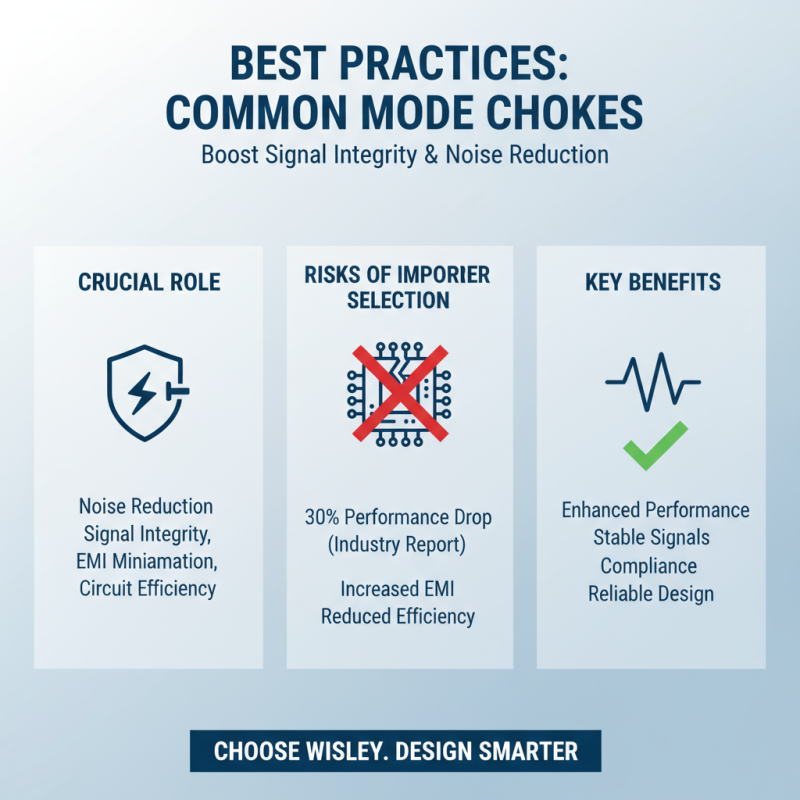
Integrating common mode chokes into your design requires careful consideration. These components play a crucial role in noise reduction and signal integrity. According to a recent industry report, improper selection can lead to a 30% reduction in performance. A well-chosen choke not only minimizes electromagnetic interference (EMI) but also enhances overall circuit efficiency.
It is essential to match the choke’s specifications with your project requirements. Parameters like impedance, current rating, and inductance need attention. A choke with too low an inductance may fail to filter out unwanted noise. Conversely, a choke with excessive inductance may hinder signal transmission. Industry experts suggest a balanced approach to avoid these pitfalls.
When designing your circuit, testing is vital. Simulation tools can provide insights into choke behavior under different conditions. However, real-world testing often reveals issues that simulations miss. For instance, a choke might perform well under ideal lab conditions but fail in practical applications. Continuous iteration and feedback are key to refining your design and ensuring the choke serves its intended purpose efficiently.