What is a Magnetic Sensor and How Does it Work?
Magnetic sensors play a vital role in modern technology. These devices detect magnetic fields and convert them into measurable signals. They are used in various applications, from smartphones to automotive systems. Understanding how a magnetic sensor works is essential for grasping its significance in our daily lives.
The operation of a magnetic sensor hinges on its ability to sense changes in magnetic fields. This can be attributed to the principles of magnetism and electronics. Various types of magnetic sensors exist, including Hall effect sensors and magnetoresistive sensors. Each type has unique characteristics and advantages, making them suitable for different purposes.
However, while magnetic sensors are valuable, their functionality can sometimes be influenced by external factors. Interference from other electronic devices may lead to inaccuracies. Continuous advancements in this field aim to enhance reliability and precision. Overall, exploring the mechanisms behind magnetic sensors reveals their importance and the challenges that accompany their use.

What is a Magnetic Sensor?
A magnetic sensor is a device used to detect magnetic fields. It can sense the presence or strength of a magnetic field. These sensors convert magnetic energy into electrical signals. They play a key role in various applications. Common uses include positioning systems, automotive tech, and industrial machinery.
Various types of magnetic sensors exist. Hall effect sensors are widely known for their reliability. They detect changes in the magnetic field when a current passes through a conductor. Magnetoresistive sensors change resistance based on the magnetic field. Each type has unique applications and benefits.
However, they also face limitations. For instance, high temperatures can affect their accuracy. This shows how we must consider environmental factors when using these sensors.
Understanding the working principle of magnetic sensors requires some reflection. They rely on physical phenomena, yet are subject to real-world challenges. Calibration and environmental impact are crucial. Users may overlook these details, leading to errors. As we explore magnetic sensors, recognizing these challenges helps in better implementation. This awareness fosters a deeper understanding of their role in technology today.
Types of Magnetic Sensors and Their Applications
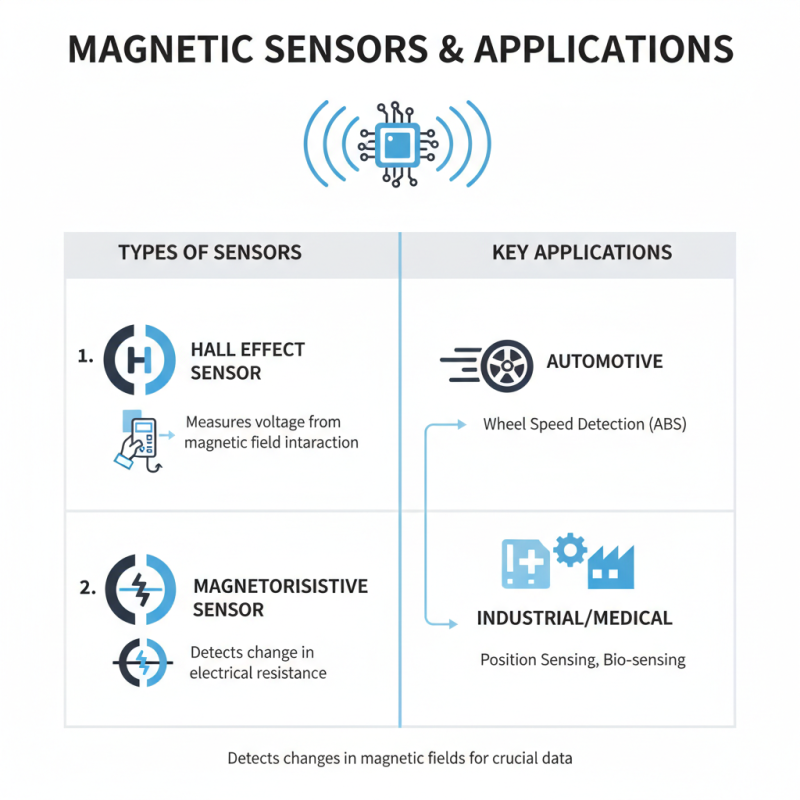
Magnetic sensors are crucial in various applications. They detect changes in magnetic fields, providing vital data for numerous industries. One common type is the Hall effect sensor. It measures the voltage created when a magnetic field interacts with an electric current. This sensor is widely used in automotive applications, such as detecting the position of wheel speed sensors.
Another type is the magnetoresistive sensor. This sensor exploits the change in electrical resistance caused by a magnetic field. It is often utilized in consumer electronics, like smartphones and gaming devices, for orientation detection. Applications also extend to industrial settings, where these sensors monitor equipment to ensure efficient operation.
However, there are challenges. Magnetic sensors can be sensitive to environmental factors, affecting their reliability. Calibration can be tricky, requiring expert knowledge to ensure accuracy. As technology evolves, the integration of these sensors into systems becomes more sophisticated, leading to improved performance and new opportunities. Yet, understanding their limitations is essential for effective deployment.
How Do Magnetic Sensors Function?
Magnetic sensors are crucial in various applications, from automotive systems to consumer electronics. These sensors detect changes in magnetic fields and convert them into electrical signals. They play a vital role in navigation systems, where accurate readings are essential for guiding vehicles and devices.
To understand how magnetic sensors function, we need to look at their components. Most magnetic sensors rely on a magnetic field-sensitive material. When exposed to a magnetic field, this material alters its electrical properties, such as resistance or capacitance. For instance, Hall effect sensors operate by measuring the voltage generated across a conductor, which experiences a magnetic field. The simplicity of this principle allows for accurate and responsive sensing.
However, there are challenges. Magnetic sensors can be affected by external factors like temperature, which may lead to inaccuracies. Additionally, interference from surrounding electronic devices can impact their performance. These aspects highlight the need for careful design and testing. Engineers continually work to improve the reliability and precision of magnetic sensors, striving to minimize errors in real-world applications.
Key Components of Magnetic Sensors
Magnetic sensors are crucial in various applications, from automotive to consumer electronics. They operate by detecting changes in magnetic fields. The key components of these sensors play a significant role in their functionality.
One primary component is the sensing element. This can be made from materials like Hall Effect sensors or magnetoresistive sensors. Hall Effect sensors use the principle of electromagnetism to produce voltage changes in the presence of a magnetic field. Magnetoresistive sensors change their electrical resistance when exposed to magnetic fields. Both elements provide high sensitivity, which is essential for precise measurements.
Another important aspect is signal processing circuits. These circuits interpret the raw data from the sensing elements. They enhance the signal quality and prepare it for output. Effective noise reduction techniques are crucial here. Poor noise handling can lead to inaccurate readings. Moreover, the integration of these sensors into devices can be challenging. Proper calibration and alignment are necessary for optimal performance. This highlights the complexity of designing reliable magnetic sensors.
Magnetic Sensor Performance Analysis
This bar chart displays the sensitivity of different types of magnetic sensors in terms of millivolts per Gauss (mV/G). Higher values indicate greater sensitivity, essential for applications requiring precise magnetic field measurements. Sensors with higher sensitivity can detect weaker magnetic fields, making them suitable for a variety of applications.
Advantages and Limitations of Magnetic Sensors
Magnetic sensors are increasingly vital in various industries, thanks to their unique capabilities. Their advantages include high sensitivity and accuracy in detecting magnetic fields. A recent market report indicates that the global magnetic sensor market is expected to reach USD 4.5 billion by 2025, showing a growth rate of 5.6% annually. This highlights the expanding reliance on these sensors in automotive applications, consumer electronics, and industrial automation.
However, magnetic sensors are not without limitations. They can be affected by temperature changes and surrounding electromagnetic interference. These factors may lead to inaccuracies in readings. For precise applications, understanding these constraints is crucial. Despite improvements, achieving stable performance in fluctuating environments remains a challenge. Furthermore, the complexity of some magnetic sensor technologies can complicate integration into existing systems.
Users must also consider the cost of advanced magnetic sensors. While they offer enhanced features, the price can be a barrier for smaller businesses. Balancing cost with performance often requires careful consideration. In many cases, simpler solutions may serve the purpose adequately without the need for high-end sensors. This reflects the ongoing discussion in the industry about optimizing resources while maintaining effective monitoring and control.
What is a Magnetic Sensor and How Does it Work? - Advantages and Limitations of Magnetic Sensors
| Aspect |
Details |
| Definition |
A device that detects magnetic fields and converts them into signals. |
| Working Principle |
Operates based on the principle of electromagnetic induction or magnetoresistance. |
| Types |
Hall effect sensors, magnetoresistive sensors, fluxgate sensors. |
| Applications |
Automotive systems, mobile devices, industrial machinery, navigation systems. |
| Advantages |
High sensitivity, non-contact operation, durable in extreme conditions. |
| Limitations |
Sensitivity to temperature changes, potential interference from external magnetic fields. |